



 3 / 8
3 / 8

w
3
Gritman goes Lean
Implementation of a single project has
streamlined processes and freed up an
average of 60 extra minutes each day,*
giving nursing sta more time to spend
on tasks related to patient-focused care.
Gritman advances
learning opportunities
Gritman Medical Center’s Foundation,
Auxiliary, and Departments of Nursing and
Education are excited to announce the pur-
chase of a new Laerdal Simulation Manikin.
The manikin—a life-sized anatomical
human model—will be used for basic to
advanced patient care training.
The manikin is paired with a computer-
ized notebook, similar to an iPad. The note-
book is loaded with software that creates a
variety of scenarios that occur in hospital or
clinical settings.
Hands-on learning for students.
Simu-
lation learning is becoming the preferred
method of training by many health sci-
ences schools, as it allows students to ex-
perience real-life scenarios in safe settings.
In rural healthcare settings, students are
provided an opportunity to practice skills
for low-frequency, high-risk procedures.
Nursing; nurse aides; andWashington,
Wyoming, Alaska, Montana and Idaho
That’s just one of many success stories since
Gritman Medical Center went Lean in 2014.
Gritman has trained hundreds of its em-
ployees on the principles of Lean, a method
for eliminating wasted time and resources.
Administrators recognized how the principles
of Lean—developed and popularized by
(WWAMI) medical students who train with
manikins gain con dence while learning
and practicing hands-on skills.
For example, a certi ed nursing assis-
tant student will need to practice and mas-
ter basic skills of obtaining blood pressure
and heart and respiratory rates. An instruc-
tor can program the manikin to have heart
sounds, breathing sounds and simulated
blood pressure. The student will provide
care for the manikin, and the accuracy of
the patient care is recorded by the manikin
and SIM technology. The results are then
displayed for the instructor and the student
to review at the end of the scenario.
Extra practice.
For experienced sta
members, including nurses, respiratory
therapists, certi ed nurse practitioners,
physician assistants and others, the
manikin provides practice to retain the
highest level of skill. Complex clinical
scenarios—such as intravenous medication
administration, insertion of a temporary
breathing tube and wound care—can all
be practiced on the manikin.
The manikin’s body functions will
respond to the participant’s actions, which
will prompt the participant to make further
assessments and decisions. The manikin is
capable of giving immediate feedback via
voice alert technology about pain, express-
ing displeasure about not being informed,
and protesting medical intervention.
Committed to great care.
The pur-
chase of the manikin was a collaborative
e ort funded with grants from the Gritman
Medical Center Foundation, Gritman
Medical Center Auxiliary and the Nursing
Department. The collaboration demon-
strates Gritman’s commitment to provide
extraordinary care to improve the health of
the people in our communities.
automobile manufacturer Toyota in Japan—
could be applied in a healthcare setting.
“The rst principle of Lean is continual
improvement,” said Lean Facilitator Jon
Wolpert. “Gritman consistently tops na-
tional benchmarks for patient care, but we
want to do even better. Implementing Lean
principles is helping us do just that.”
After training, employees were encour-
aged to look at their unique roles within
the hospital and nd opportunities for
improvement. The results have been aston-
ishing. Literally every department has seen
improved e ciency, thanks to the changes
made by employees at every level.
The result: Gritman Medical Center can
provide the best possible care with even
faster results and less waste.
*Average time based on 30 minutes saved per 12-hour shift.
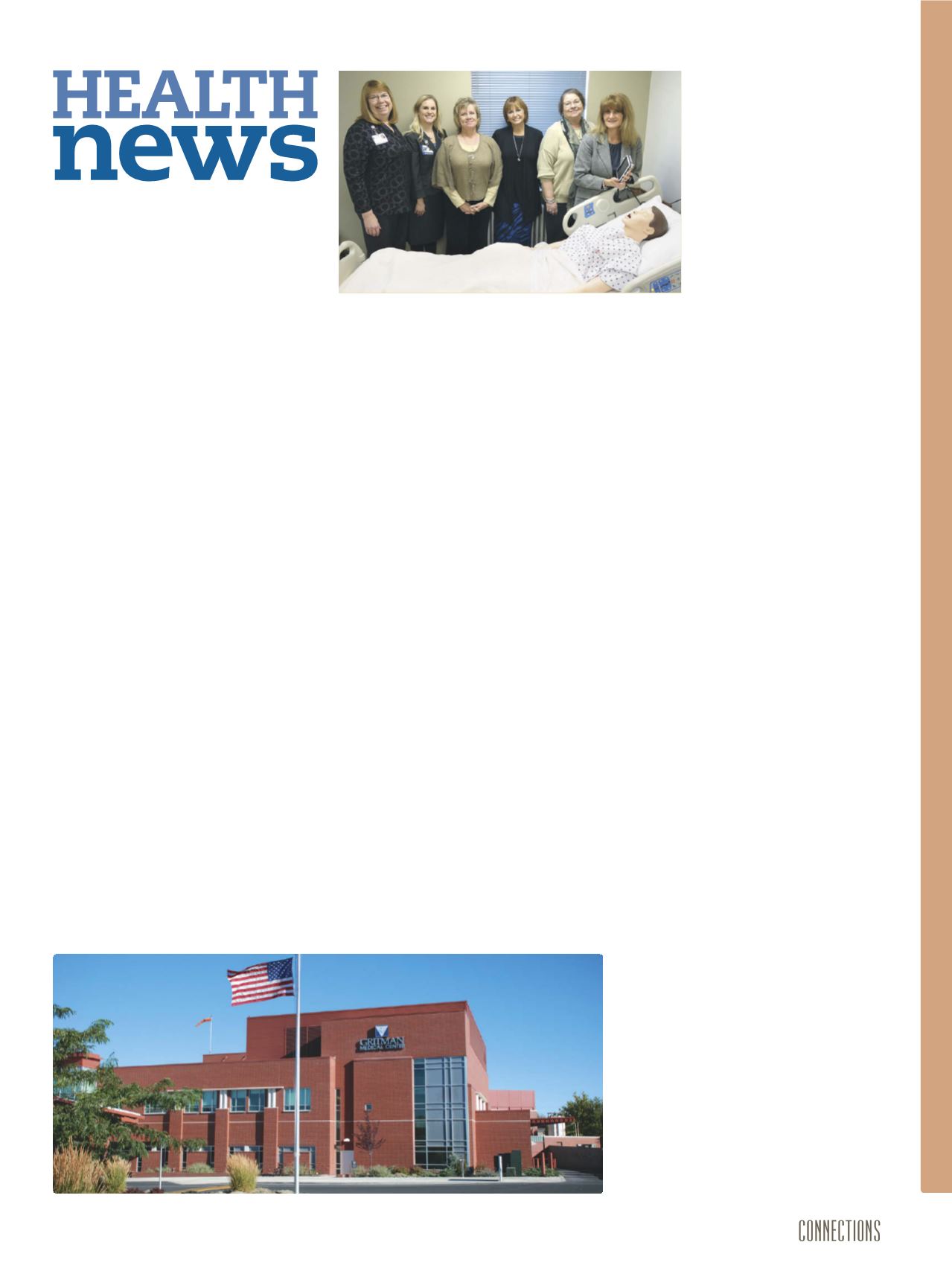
From left are Sheryl Washburn,
CNO; Adina Bielenberg, Director
of Marketing and Development;
Deb Meshishnek, Education
Coordinator; Debi Dockins,
Director of Volunteer Services;
Mary Woods, Auxiliary President;
and Pam Hays, Foundation
President.